
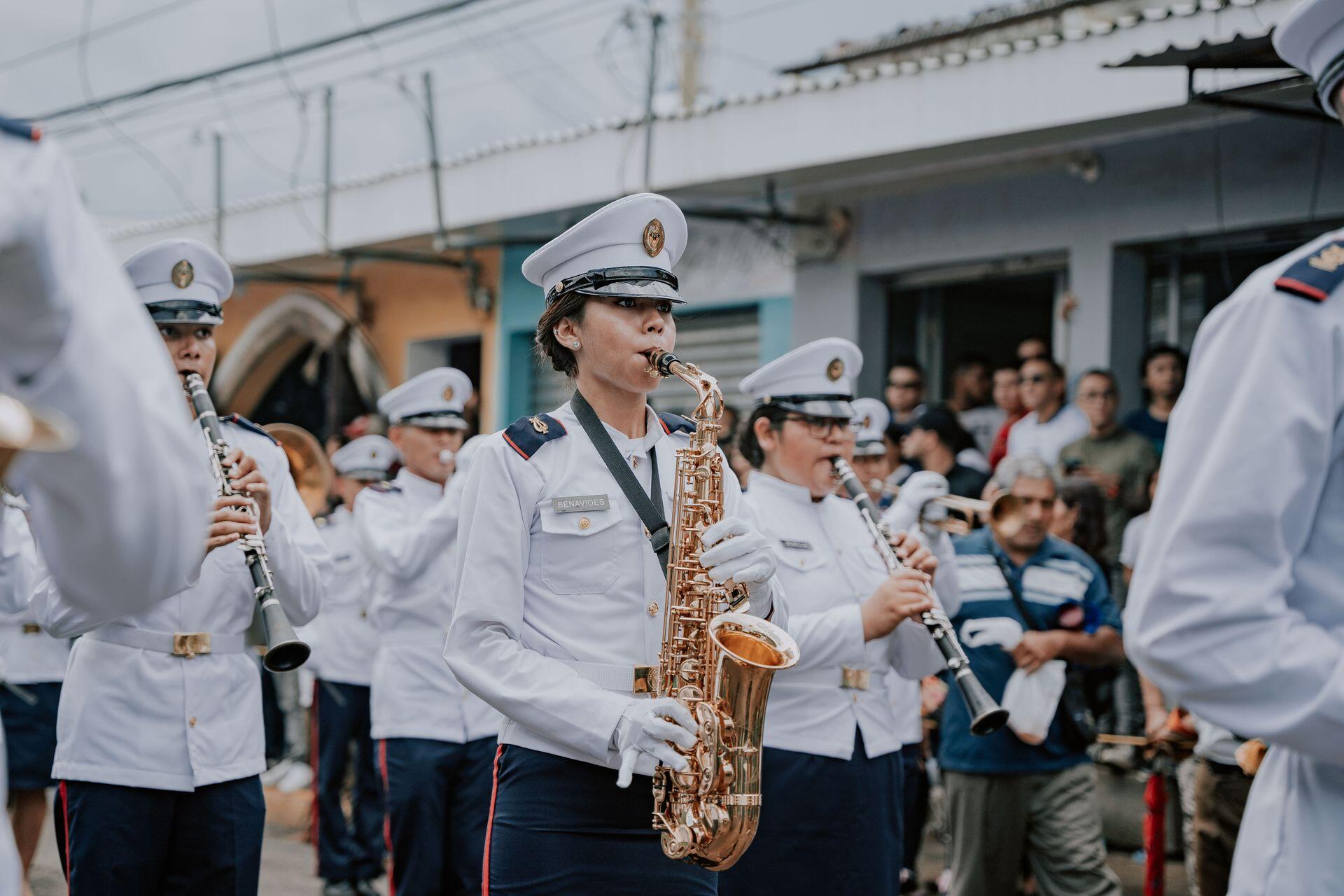

The woodwind section of a marching band adds more colour to the melody, along with movement and liveliness. They fill out the highest tones in a musical arrangement, adding flourishes and emphasis at just the right moments in a song. Discover what instruments belong to the woodwind family, and the roles each woodwind plays within the section itself.


Woodwind Family Instruments
The woodwind family of instruments is fairly large. It includes instruments with very different shapes and pitch ranges, as well as playing methods. In concert settings, there can be a wider variety of instruments available, as they are easy to hear in a controlled setting. In marching bands, some instruments are not very suitable since they’re hard to hear in a loud, outdoor setting.
Flute
The concert flute is usually the highest woodwind instrument in a marching band, though sometimes piccolos make an appearance. It is held sideways and played by blowing a focused stream of air across the embouchure hole. It does not have a reed.
The flute has a clear, bright sound that soars above the lower instruments. Its light weight makes it easier to handle than some larger instruments, so it’s a good choice for younger and smaller players.
The downside is that it can be harder to project the sound, especially on a windy day that makes blowing the required air stream more difficult.
Flautists use keys to open and close tone holes. The standard concert flute can produce a range of around three octaves.
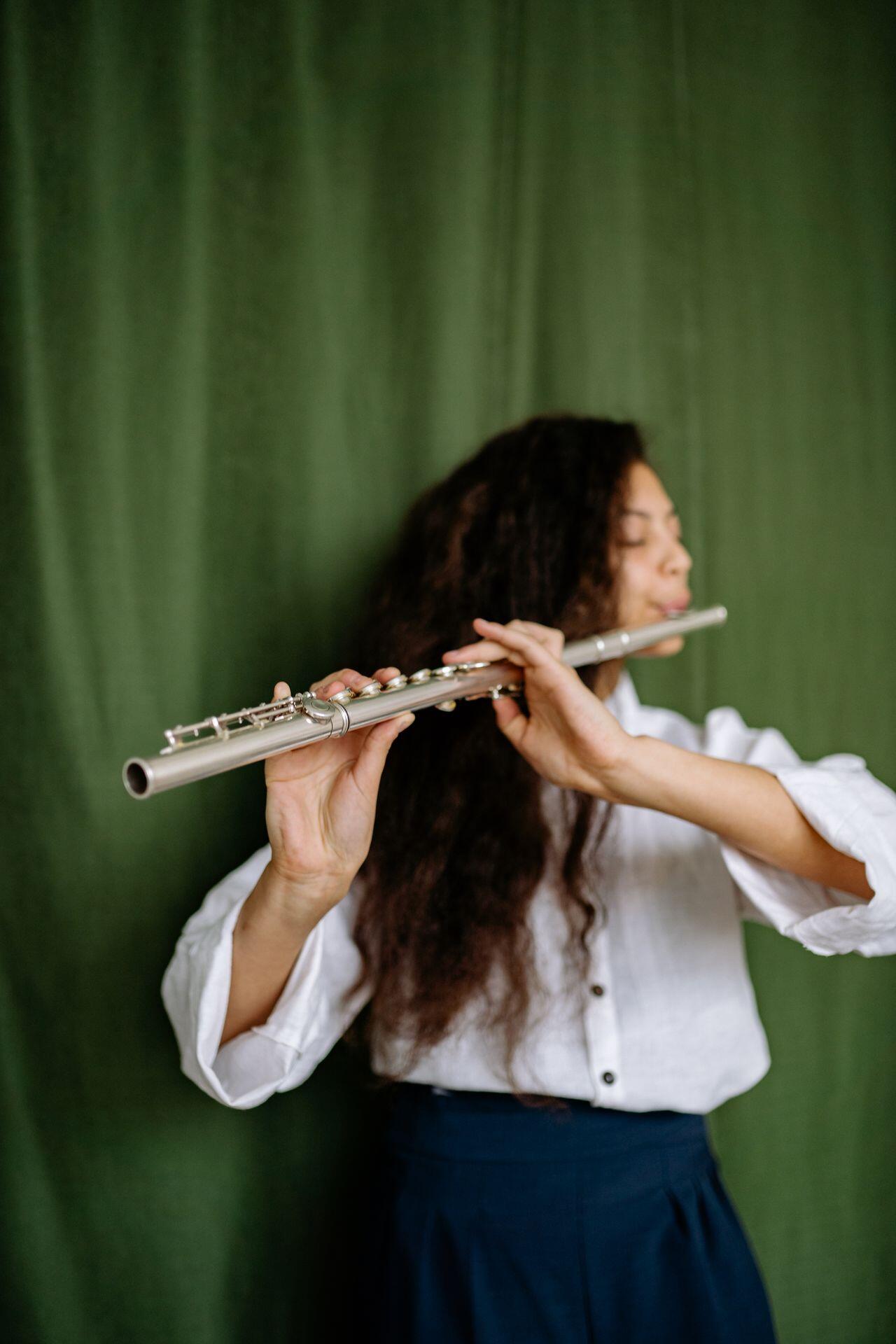
In marching band pieces, flutes and piccolos add dramatic flair on top of the melodies created by the brass section and the rest of the woodwinds. They can easily trill and navigate between many notes quickly.
flutes
Clarinet
One of the most common marching band woodwind instruments, clarinets use a single reed in the mouthpiece to create tones. When the player blows into the mouthpiece, the reed vibrates and resonates through the body and out the flared bell.
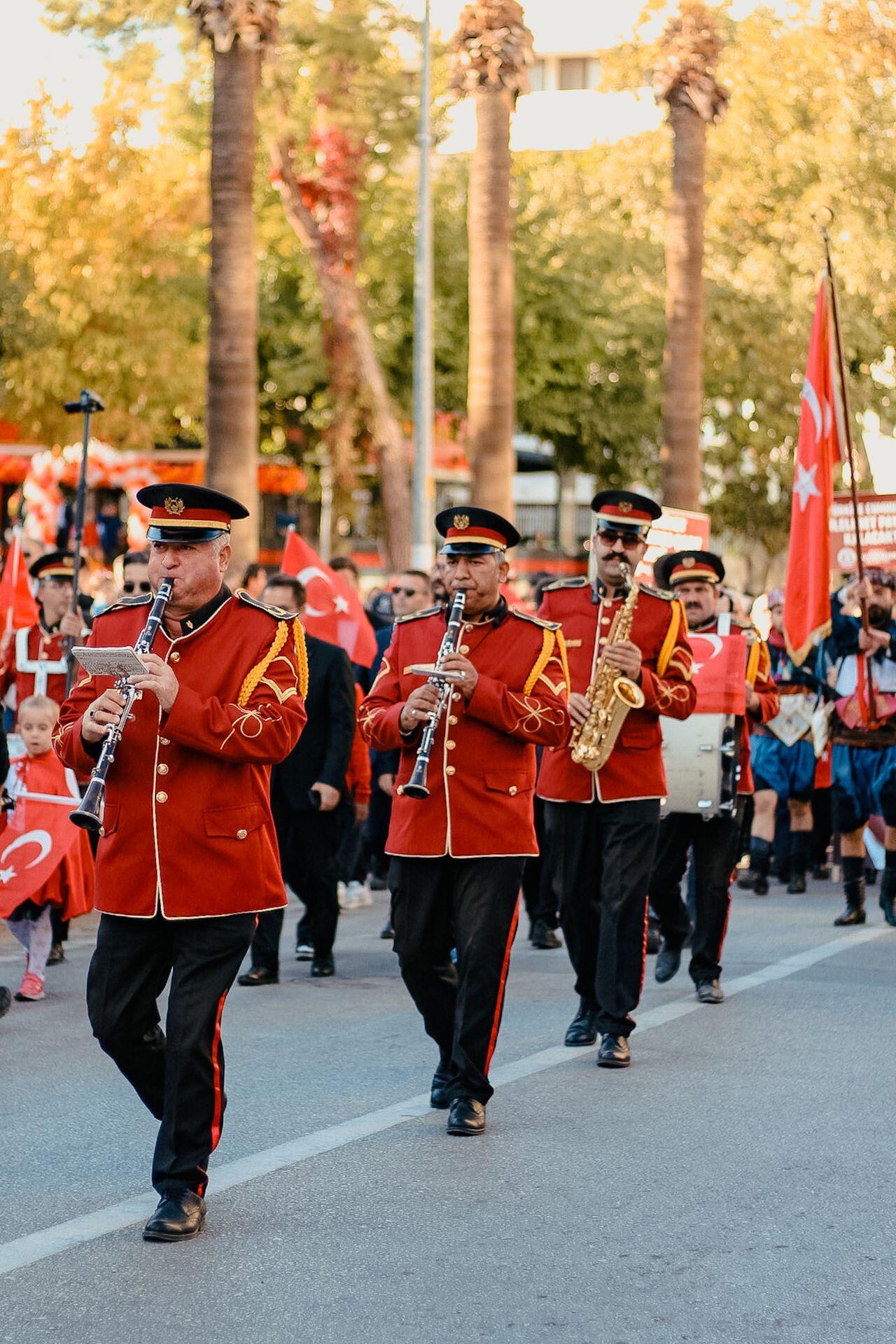
Clarinets are portable, light, and perfect for musical beginners. They can play melodies, harmonies, and fast, technical passages.
In marching band music, they can fill many roles, such as backing the main harmony, providing counter-harmony, and flourishes.
Bass clarinets tend to overlap too much in range with other brass and woodwind instruments, making them indistinct to audiences. Therefore, they are usually only used in concert settings.
Saxophone
Within the saxophone family, there are four main options:
- Soprano saxophone
- Alto saxophone
- Tenor saxophone
- Baritone saxophone
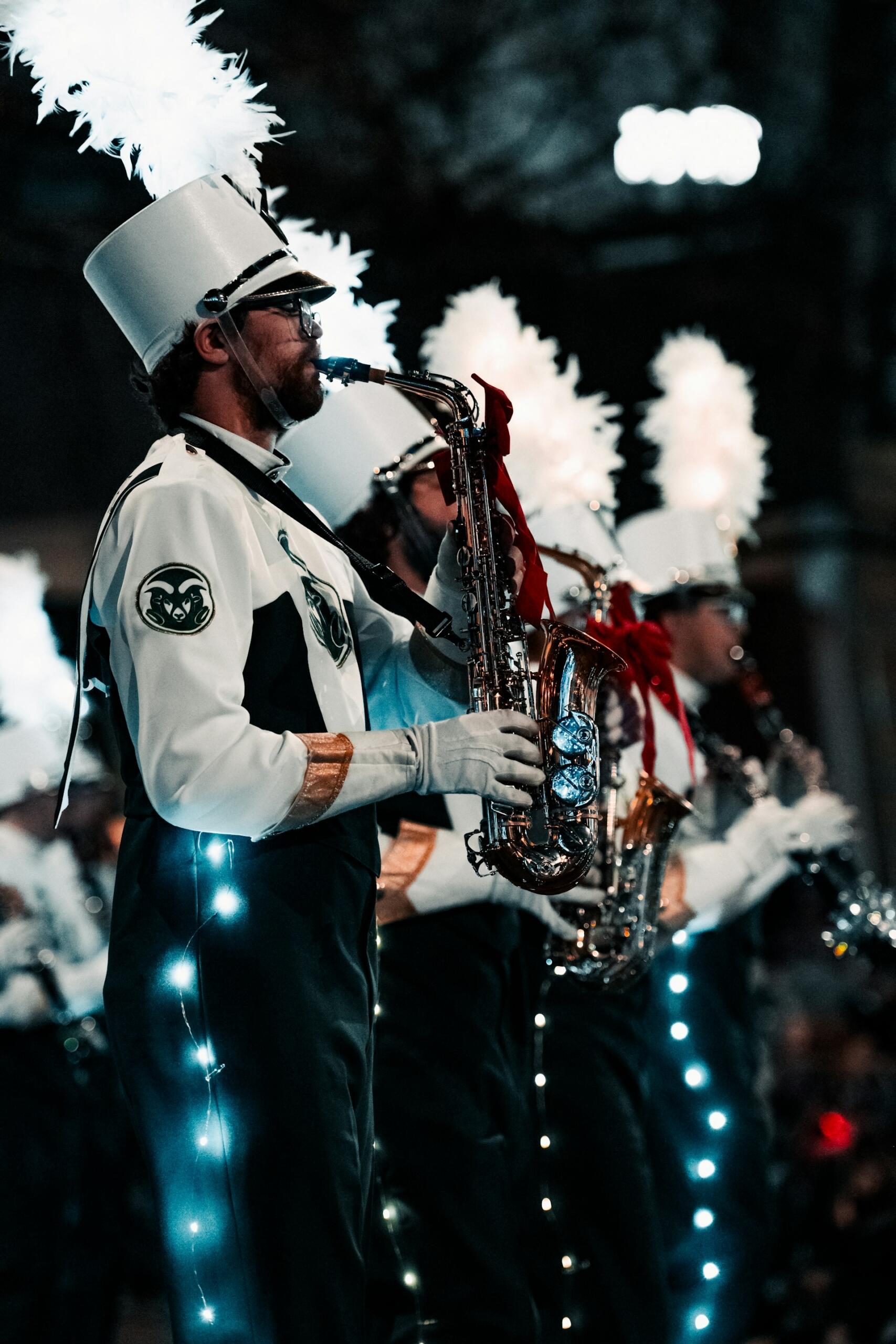
In marching bands, alto and tenor sax are the most common. Alto saxophone produces strong, full sounds, while tenor sax creates a lower, richer tone. Both support the harmony and rhythm of the whole band.
They are valued in marching music because they are excellent projectors. Saxophones can weave in and out of the brass and other woodwinds’ parts seamlessly, providing emphasis and support.
Although usually made from brass, saxophones are a woodwind instrument because they use a reed in the mouthpiece.
Saxophones, like the other woodwinds in a marching band, rely heavily on cues from the drum major and the drumline to stay on beat. It's easy for woodwinds to lose track of the rhythm when playing flourishes and non-melodic parts.
Oboe
The oboe uses a double reed in the mouthpiece, which creates a more complex sound. In a concert, the oboe produces a highly distinct and recognisable tone that stands out, often described as reedy, bright, and penetrating.
Double-reed instruments are generally very expensive and delicate. Their sound does not project well in open spaces. If they are used in a marching band, it’s with great care. They usually require a microphone and will be used for solos, especially in field performances.
Oboes are less common in marching bands because they are very delicate and their sound is more suited for concert settings. Oboes are highly sensitive to temperature and humidity changes, so they may not work properly depending on the weather. Their double reed can also easily cause injury to the mouth if the player is bumped. Most oboe players in marching band switch to piccolo, flute, clarinet, or saxophone.
Bassoon
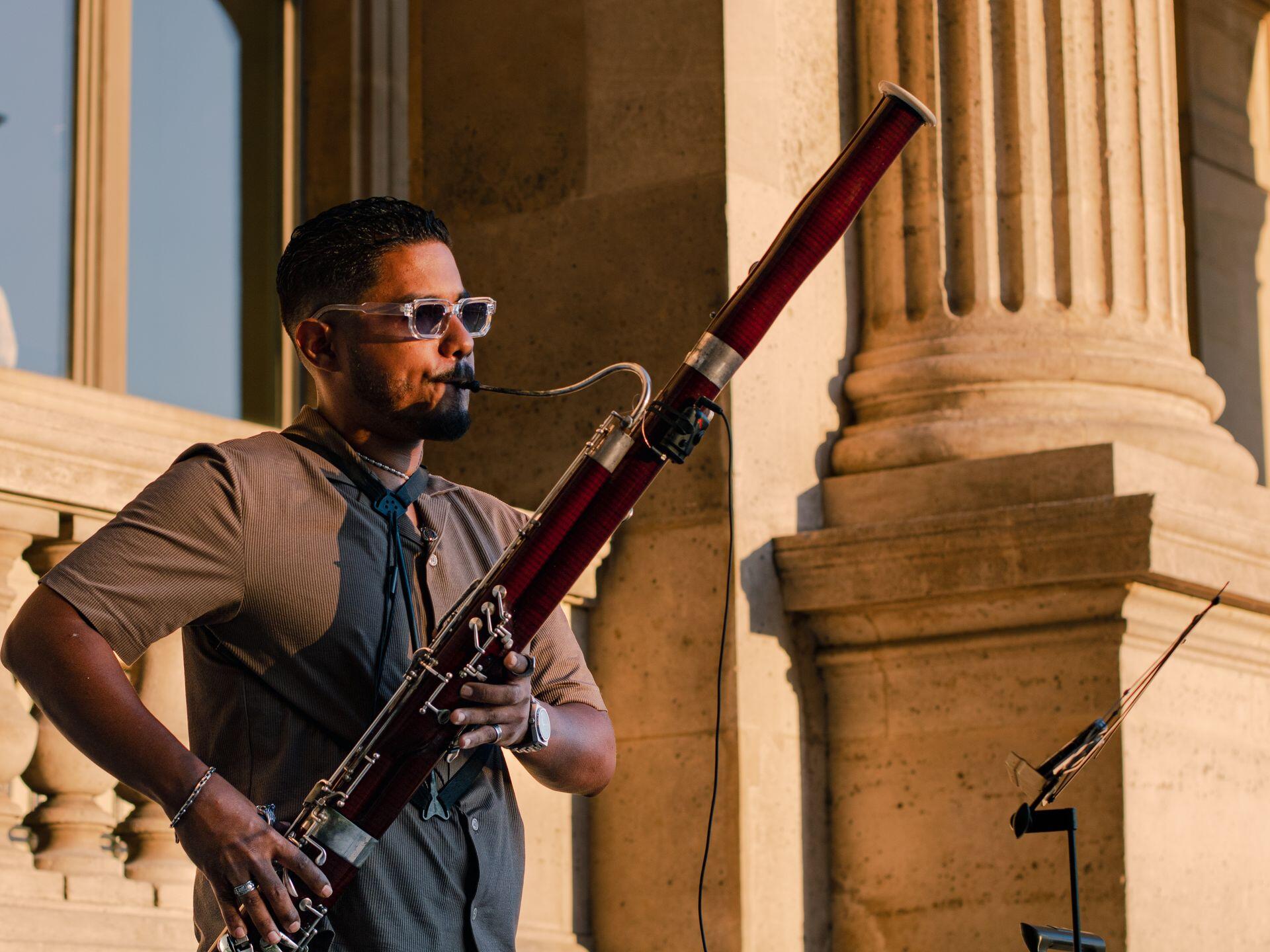
The bassoon is a large double-reed instrument that produces very low notes. Like oboes, they are very fragile and prone to weather-related problems and can cause mouth injury. They are also very large, expensive, and don’t project their sound well, so they are not usually found in marching bands.
They can be considered auxiliary instruments, since they may only be used for very short amounts of time at specific moments, if they make an appearance at all.
Other Woodwind Instruments
There are many other woodwind instruments to be aware of as well. Some appear frequently in marching bands, while others are typically reserved for concert bands. Check out this list of woodwind instruments to find out more about other common woodwinds in concert and marching band.
| Instrument | Usual pitch or range | How it produces notes | Typical sound |
|---|---|---|---|
| Piccolo | Very high; approximately D5–C8. Sounds one octave above its written notes. | Flute-like mouthpiece hole. Keys change the vibrating length of the air column. | Bright, piercing, strongly projecting. |
| Flute | Medium-high to high; approximately C4–C7. Some concert flutes extend down to B3. | Mouthpiece hole. Keys open and close holes to change pitch. | Clear, airy, lyrical, bright. |
| Recorder | Varies by size. Descant/soprano: approximately C5–D7. Treble/alto: approximately F4–G6. | A mouthpiece channel directs air against a sharp edge. Fingers cover or uncover holes. | Clear and whistle-like. Descants are brighter; trebles are warmer and more mellow. |
| Clarinet & bass clarinet | Standard: approximately D3–B-flat6 sounding pitch. Bass: Low to medium-high; approximately B-flat1–F5 | Air makes a single reed vibrate against the mouthpiece. Fingers and keys open or close holes to change pitch. | Dark, warm and woody in the lower register; clear, bright and resonant higher up. |
| Oboe | Medium-high; approximately B-flat3–G6. | Air passes between two cane reeds, making them vibrate. Finger-operated keys change pitch. | Focused, reedy, penetrating and expressive, slightly nasal. |
| Cor anglais / English horn | Middle register; approximately E3–C6 sounding pitch. Sounds a perfect fifth below its written notes. | A double reed sits on a curved metal tube. Air vibrates the reeds, and keys control pitch. | Warm, mellow, dark and plaintive. |
| Bassoon | Low to medium-high; approximately B-flat1–E-flat5. | Air vibrates a double reed attached to a curved metal tube. Keys and finger holes control pitch through a long, folded bore. | Deep, reedy, woody and resonant. |
| Contrabassoon | Very low; approximately B-flat0–D4. Sounds one octave below its written notes. | A double reed produces vibrations in a very long, folded air column. Keys change its sounding length. | Very deep, dark and weighty. |
| Alto Saxophone & Tenor Saxophone | Alto: Middle to high; approximately D-flat3–A-flat5. Tenor: Low-middle to high; approximately A-flat2–E5 | Air vibrates a single reed against the mouthpiece. Keys open and close holes along the metal body. | Reedy and resonant; warm and rounded or bright and projecting. |
| Bagpipes | Varies by type. The Great Highland bagpipe chanter normally has nine notes, named low G to high A. Modern instruments commonly sound sharper than these concert-pitch note names. | Air from the bag drives a double reed in the melody pipe and single reeds in the drones. Fingers change melody notes; drones sustain fixed pitches. | Strong, penetrating, bright and commanding, with a continuous drone underneath. |
Types of Woodwind Instruments
Within the woodwind family, there are generally three main groups. Instruments are generally sorted by how they produce sound.
Woodwind instruments produce music when the player blows air across a hole or through a tube without buzzing their lips.
Flute Instruments
Flutes have lip plates and embouchure holes rather than mouthpieces with reeds that are encircled by the lips, as is the case with other woodwinds. Flutes were traditionally made of wood, like traditional pipes, which contributes to their being considered woodwind. Even though modern flutes (concert flutes) are made of metal, they don’t involve buzzing lips in a conical mouthpiece, so they are furthermore solidly in the woodwind category rather than brass.
The flute is the most perfect of all instruments, because it can express the highest and lowest notes with equal ease.
Heinrich Heine
Flutes usually use keys to cover various holes in the body of the instrument. Though, traditional flutes usually have holes that are covered directly with fingers. Pan flutes achieve different tones by having flutes of different lengths, and therefore notes, tied together, rather than using holes. For the most part, flutes have long, straight bodies.
Flutes in Marching and Concert Bands
- Piccolo
- Concert flute
- Alto flute
- Bass flute
Other Types of Flutes
- Contrabass flute
- Hyperbass flute
- Wooden flutes
- Pan flutes
- Ocarina
- Bansuri
- Shakuhachi
Single-reed Instruments
This instrument family uses one thin strip of cane or a synthetic equivalent fastened to a mouthpiece. The embouchure for single-reed instruments involves placing the reed against the lower lip, which is folded over the top of the bottom teeth. The tip of the mouthpiece goes in the mouth and is encircled by the lips, unlike the method used for flutes.
When the player blows, the reed vibrates against the other part of the mouthpiece and creates a sound. Most single-reed instruments use keys to cover and uncover holes to change the pitch. The instruments in the single-reed category can vary widely in shape, from saxophones to clarinets.
In marching, these instruments work together well with the color guard to emphasize one another through both visual and audial flourishes.
Single-reed instruments in marching and concert bandsconcert bands
- Clarinet
- Saxophones
- Some bagpipes
Other types of single-reed instruments
- Aulochrome
- Octavin
- Tárogató
- Mijwiz
Double-reed instruments
Double-reeded instruments use two reeds face to face, rather than one red and a solid surface, as in single-reeds. The embouchure for double-reeds requires careful control. It involves folding the top lip over the edges of the top teeth, just like the lower teeth, and holding the reeds between the lips.
Air passes between a small opening between the two reeds and they vibrate together. The sound is more restrained, though it can also be very expressive. They can be very difficult to play, especially for beginners. As previously mentioned, they are also very expensive, fragile, prone to humidity and temperature-related problems, don’t project sound loudly or far, and are therefore not typically found in marching bands.
Double-reed Instruments in Concert Bands
- Oboe
- English horn
- Bassoon
- Contrabassoon
- Some bagpipes
Other Types of Double-reed Instruments
- Algaita
- Bombard
- Duduk
- Gralla
- Surnay
- Tangmuri
- Tenora
How to Identify Woodwind Instruments
Woodwinds can be identified mostly by looking at the mouthpiece. Since they can be made out of a variety of materials, it can be easy to confuse them with brass instruments if you don’t know what to look for. Rather than focus on the material, noticing if the mouthpiece is flute-like or if it has a reed is a surefire way to recognise a woodwind.
Along the same lines, noticing how sound is produced is also an indicator. Brass instruments require the player to buzz their lips in the mouthpiece. Woodwinds unilaterally do not. As for the other instruments in marching band, it's easy to tell woodwinds apart.
Choosing the Perfect Woodwind Instrument for You
Selecting an instrument requires thought and intuition. The instrument should suit your musical interests as well as your body size, budget, and access to tuition.
Typically, you can try out a variety of instruments at a music shop or through a music teacher. Many schools and community music groups also have trial sessions. You can get a feel for the instrument, get familiar with how they sound, and learn more about the technical details of playing them.
You’ll also need to consider if there are any teachers available near you for your specific instrument. If your school or local music programme doesn’t have any options, you’ll need to find a private tutor. This will contribute to a higher overall cost. Also consider that larger instruments and double-reed instruments are usually much more expensive.
Here are some tips for each popular woodwind instrument:
Flutes suit learners interested in high, light sounds that can carry melodies and make trills. The instruments are light and compact. They require a specific embouchure that can get tiring, but they don’t have any reeds to replace.
A strong all-around choice, clarinet often prepares learners for other instruments (like saxophone) as well. They are reasonably small and very versatile, so you’ll be exposed to different roles in music.
A popular choice, saxophones are a bit heavier and bulkier, and more expensive. They are well-suited for a wide variety of musical genres and parts.
The most common double-reed instruments, they usually require an attentive, specialised teacher. They are very complex, heavy, and expensive. Students interested in concert music are the best demographic for this type of instrument.
Woodwinds are just as crucial for a successful marching band or concert band as the percussion section and brass section. They have a wide variety of musical possibilities, making them an interesting and versatile choice.
References
- Allen, Andrew J. “Woodwinds on the Field.” The Instrumentalist, 28 Mar. 2015, theinstrumentalist.com/april-2015/woodwinds-on-the-field. Accessed 5 Oct. 2026.
- Lortz, Mark. “Arranging Music for Small Marching Bands.” The Instrumentalist, 26 Apr. 2019, theinstrumentalist.com/may-2019/arranging-music-for-small-marching-bands. Accessed 5 Oct. 2026.
- Sen, Kan. “The 10 Most Common Marching Band Instruments: An Expert Guide for Musicians.” Cosmos, 23 July 2026, www.cosmoshandpan.com/blogs/news/the-10-most-common-marching-band-instruments-an-expert-guide-for-musicians?srsltid=AU7gw4VjE4GT7RGuIK9RcKTleofQ_L2FKUQSV2Zq_SsnYyribnhBClm-. Accessed 5 Oct. 2026.
Summarise with AI:
Did you like this article? Leave a rating!

 Loading...