

Whether you are a native English speaker or someone who's learning English as a second language, you're bound to come across vocabulary or words that might seem bizarre or don't make sense at first glance.
The generation and usage of unusual English words is actually pretty common in different English-speaking countries around the world — something we'll explore more deeply in this article.
Key Takeaways
- A word may seem strange because of its rarity, pronunciation, meaning, spelling, length, or origin.
- Countries and regions like the UK, the US, Australia, and Canada have their fair share of strange English words due to local culture and contexts.
- To use strange words naturally in English, it's best to learn their meanings, origins, and practice them in the right contexts without overusing them in everyday conversations.


🧐 What Makes a Word Strange?
Language is a process of free creation; its laws and principles are fixed, but the manner in which the principles of generation are used is free and infinitely varied. Even the interpretation and use of words involves a process of free creation.
Noam Chomsky
Strange words often stand out for these main reasons:
- They're rare: Hardly used in daily conversations or normal text
- They sound unique or have difficult pronunciation: May sound awkward or unexpected
- They have unexpected meanings: Description of an idea (with a surprising element)
- They have interesting origins: May come from another language or historical source 1

Let's explore more examples in detail.
🌀 Unusual Words That Are Rare
These words are rarely used in your everyday conversations, but they definitely exist.
Susurrus
Meaning: A soft whispering or rustling sound.
Pronunciation:suh-SUR-us
Petrichor
Meaning: The pleasant smell after rainfall.
Pronunciation: PET-ri-kor
Eunoia
Meaning: Beautiful thinking or a well-balanced mind.
Pronunciation: yoo-NOY-uh
🌀 Unusual Words That Are Hard to Pronounce
Worcestershire
Meaning: A county in England and the name of a famous sauce.
Pronunciation: WUSS-tuh-sheer
Onomatopoeia
Meaning: When a word mimics the sound it describes (e.g., "buzz," "sizzle," "clang")
Pronunciation: on-uh-MAT-uh-PEE-uh
Anemone
Meaning: A type of delicate flower; also a predatory sea creature (from Greek "anemos" = wind)
Pronunciation: uh-NEM-uh-nee 2
🌀 Unusual Words With Strange Meanings
Defenestration
Meaning: The act of throwing someone or something out of a window.
Pronunciation: dee-fen-uh-STRAY-shun
Limerence
Meaning: An intense feeling of romantic infatuation.
Pronunciation: LIM-er-ents
Gobbledygook
Meaning: Language that is confusing or difficult to understand.
Pronunciation: GOB-ul-dee-gook
🌀 Unusual Words With Interesting Origins
Robot
Origin: From the Czech word robota, meaning forced labour.
Meaning: A machine that performs tasks automatically.
Tsunami
Origin: Japanese harbour wave (tsu = harbor, nami = wave)
Meaning: Large sea wave (that could potentially be disastrous)
Kerfuffle
Origin: Roots from the Scottish verb fuffle (dishevel, make untidy)
Meaning: A commotion or disturbance
🔤 The Longest Words In The English Language
Now, let's have a little fun and analyse the following overwhelmingly long words featured in the English language. Long, strange words exist for these reasons:
✨"Medical"/Scientific term: Pneumonoultramicroscopicsilicovolcanoconiosis
Number of letters
- Meaning: A pneumoconiosis caused by inhalation of very fine silicate or quartz dust
- Invented in 1935 by Everett M. Smith, then-president of the National Puzzlers' League
✨ Linguistic Joke: Hippopotomonstrosesquippedaliophobia
Number of letters
- Meaning: Fear of long words
- Coined by the American poet Aimee Nezhukumatathil in 2000 3
✨ Popular Culture: Supercalifragilisticexpialidocious
Number of letters
- Meaning: Something that is wonderful, extraordinary, or delightful
- A nonsense word made popular by the beloved Disney classic, Mary Poppins, starring Julie Andrews
✨ Historical and Political term: Antidisestablishmentarianism
Number of letters
- Meaning: To be against a movement of the separation of church and state
- Mostly used in textbooks in the historical or religious context, and rarely in daily conversations
Meanwhile, explore some of the most common errors one can make when learning English.
🌍 Unusual Words Around the World
We'll be focusing on the UK, the US, Australia, and Canada — four countries where English is the primary language.
'American English' is the most widely spoken. Of all official English-speaking countries, the United States is the one that boasts the most native speakers, with over 245 million according to recent estimates.
🎩 Unusual Words In British English
The following are some examples of weird words in English that UK citizens say:
Origin and Meaning: From the Middle Ages; refers to a person wearing rags or dirty clothes, often scruffy or poorly dressed.
Sentence example: Tuck your shirt in; you look like a ragamuffin.
Origin and Meaning: British slang for nonsense; not related to fish despite "cod" in the word.
Sentence example: Some say he’ll be the next President. Codswallop!
Origin and Meaning: An informal British word for being absent from school or work without permission.
Sentence example: Gary always tries to skive off on Friday afternoons to go to the football match.
You'll notice that many British English strange words are slang or meant for local contexts, reflecting aspects of British culture and the long history of English. For example, British culture is known for its wit and dry humour, so words like codswallop (nonsense) and ragamuffin (scruffy person) tend to have a teasing or critical connotation.

🍔 Weird English Words in American English
The following are just some examples of the strange English words used by Americans:
Origin and Meaning: American slang (1920s); an extraordinary thing, person, or event
Sentence example: The music festival was a real lollapalooza with amazing performances from every band.
Origin and Meaning: American South/Midwest (1840s); confused, diagonal, or askew
Sentence example: When I got back home, I could see someone had entered during my absence. The shelves were all cattywampus, and some books were missing.
Origin and Meaning: American (1830s); to confuse or upset someone
Sentence example: The complicated instructions completely discombobulated the new employee.
While it’s interesting to discover the weirdest words in UK English and US English, it can also be fun to compare words that have the same meaning but are different in terms of the actual word used.
| UK English Word | US English Word | Definition |
|---|---|---|
| Holiday | Vacation | A time spent away from work and home to relax |
| Chips | Fries | Potato slices fried until crispy |
| Trousers | Pants | A garment covering the body from the waist down with a separate part for each leg |
| Queue | Line | People aligned waiting for their turn |
| Lift | Elevator | A device inside some buildings that allows people to go up and down faster than using the stairs |
| Biscuit | Cookie | A small baked treat, typically sweet |
| Bank Holiday | National Holiday | A public holiday recognised by law |
🦘 Unusual Words in English Used in Australia
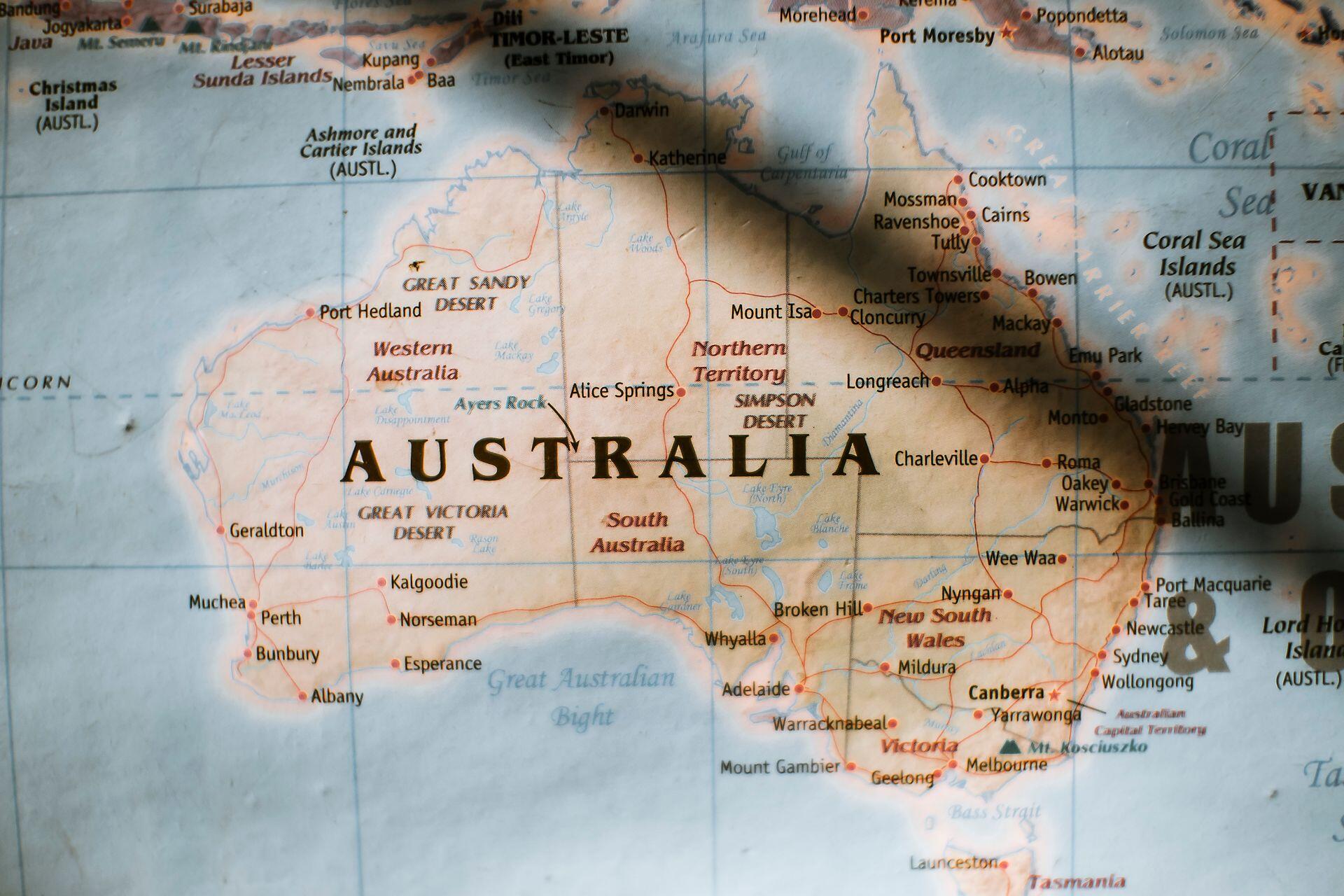
Oceania features two predominantly English-speaking countries, Australia and New Zealand. However, in today's article, we will primarily focus on Australia and will now consider some of the weirdest words in English commonly spoken by its citizens.
Examples
Origin and Meaning: This word describes a pond in a dry riverbed, an oxbow lake. It’s most likely derived from the Wiradjuri language, which “describes a pond or a pool of water that is left behind when a river alters its course”.
Sentence example: I’m so excited to finish the hike. At the end, we can chill and bathe in the billabong.
Origin and Meaning: A word commonly used in Australia that describes someone who is known as a 'redneck.' Friends also use it amongst themselves when one of them is acting weird
Sentence example: That man over there is a significant bogan mate.
Origin and Meaning: A portable cooler used to keep food and drinks cold. Originally a brand name that became generic. (Just like Kleenex)
Sentence example: Bring your drinks and put them in the esky.
Fun Fact: Australian English has many "strange" words that are actually abbreviations. 4 Some examples include:
- Arvo: Afternoon
- Servo: Service station
- Brekkie: Breakfast

🍁Strange Words in Canadian English
While many outsiders view Canada and the United States as two peas in a pod, Canada has a wide variety of strange English words and expressions that are not comprehended by Americans and can only be understood by Canadian citizens.
Origin and Meaning: Loonie is a Canadian word used to describe a one-dollar coin; it is called this because it has a picture of a loon (a waterbird)
Sentence example: I have a loonie in my pocket.
Origin and Meaning: A tuque is a knitted hat that is used to keep your head warm during winter. Many Canadians do not realise that this word is not used outside of Canada.
Sentence example: I wore my tuque to go skiing.
Origin and Meaning: Hoser is a derogatory term used for someone who’s uncivilised. An idiot to make it short.
Sentence example: The more I’ve seen how he behaved at dinner, the more I was convinced he was a hoser.
In the case of Canadian English, these words seem strange not because they are rare, but because their meanings are unique to a particular region.
🤯 How to Use These Words
Now that you have explored a wide range of strange words in English, let's look at some tips to use them aptly.
Learn the meaning and pronunciation
- Don't be taken aback by new vocabulary.
- Check out its meaning and origins, and try to form a sample sentence to remember it better
Use it in the right context
- Check if it is a local slang or a colloquial term you can use with the right group of people
- Be sure that the other party knows the meaning of the words
Don't overuse
- Don't overuse them in daily conversations (especially long words)
- Feel free to use them naturally in games like Scrabble, crosspuzzles, or spelling bees!
We hope you have enjoyed learning about different forms of strange words in English and their meanings.
Don't use words too big for the subject. Don't say 'infinitely' when you mean 'very'; otherwise you'll have no word left when you want to talk about something really infinite.
C.S.Lewis
References
- 22 Weird Words to Know and Love. (2024, January 22). 22 Weird Words to Know and Love, with Examples | Grammarly. https://www.grammarly.com/blog/vocabulary/weird-words/
- 10 of the hardest English words to pronounce ‹ EF GO Blog | EF Global Site (English). (2026). EF GO Blog | EF Global Site (English). https://www.ef.com/wwen/blog/language/hardest-english-words-to-pronounce/
- What is hippopotomonstrosesquippedaliophobia? (n.d.). Www.sciencefocus.com. https://www.sciencefocus.com/science/what-is-hippopotomonstrosesquippedaliophobia
- The modern guide to Aussie slang | Study in Australia. (n.d.). Www.studiesinaustralia.com. https://www.studiesinaustralia.com/Blog/about-australia/the-modern-guide-to-aussie-slang
Summarise with AI:
Did you like this article? Leave a rating!

 Loading...