


The world of poetry can be complex, confusing, and overwhelming for some, but it can also bring insights, raw emotion, and rich imagery to readers. One of the ways that poetry writing can shine is through the use of poetic techniques and devices. Poetry techniques can draw the reader into an emotional state and help them to understand the true meaning of that poem.
| Poetic technique | What does it mean? | What is it used for? | Example |
|---|---|---|---|
| Alliteration | Repetition of the same consonant sound at the beginning of nearby words. | Creates rhythm, emphasis and memorable sound. | “Wild winds whistle” |
| Assonance | Repetition of vowel sounds in nearby words. | Creates musicality, mood and emphasis. | “The rain in Spain” |
| Consonance | Repetition of consonant sounds within or at the end of nearby words. | Adds rhythm, sound patterns and texture. | “Blank and think” |
| Sibilance | Repetition of soft s, sh, z or similar sounds. | Can create a soothing, sinister or tense atmosphere. | “The snake slithered silently” |
| Onomatopoeia | Words that imitate or suggest real sounds. | Makes sounds more vivid and immersive. | “The leaves rustled” |
| Rhyme | Repetition of similar sounds, usually at the ends of lines. | Creates rhythm, musicality and structure. | “Light / night” |
| Euphony | The use of pleasant, flowing or harmonious sounds. | Creates a calm, beautiful or soothing effect. | “Mellow wedding bells” |
| Cacophony | The use of harsh, discordant or jarring sounds. | Creates tension, discomfort or a sense of chaos. | “Crash, clatter, crack” |
| Metaphor | A direct comparison in which one thing is described as being another. | Creates deeper meaning and striking comparisons. | “The world is a stage” |
| Simile | A comparison between two things using “like” or “as”. | Makes descriptions clearer and more vivid. | “Her smile was like sunshine” |
| Personification | Giving human qualities, emotions or actions to non-human things. | Makes abstract or inanimate subjects more relatable and vivid. | “The wind whispered” |
| Imagery | Descriptive language that appeals to the senses. | Helps readers picture, hear, smell, taste or feel what is being described. | “The warm, golden sun” |
| Symbolism | Using an object, person, place or image to represent a deeper idea. | Adds layers of meaning and reinforces themes. | “A dove symbolises peace” |
| Hyperbole | Deliberate exaggeration that is not meant to be taken literally. | Emphasises an idea, feeling or situation. | “I’ve told you a million times” |
| Juxtaposition | Placing contrasting ideas, images or subjects close together. | Highlights differences and creates tension or complexity. | “Darkness beside light” |
| Allusion | An indirect reference to a well-known person, event, text or idea. | Adds meaning by drawing on the reader’s existing knowledge. | “He was no Romeo” |
| Irony | A contrast between what is said or expected and what is actually meant or happens. | Creates humour, tension or deeper meaning. | A fire station burns down |
| Anaphora | Repetition of a word or phrase at the beginning of successive lines or clauses. | Creates emphasis, rhythm and emotional impact. | “We will fight. We will endure. We will win.” |
| Epistrophe | Repetition of a word or phrase at the end of successive lines or clauses. | Reinforces an idea and creates a strong rhythmic effect. | “See no evil, hear no evil, speak no evil” |
| Rhetorical question | A question asked to make the reader think rather than receive an answer. | Encourages reflection and emphasises an idea. | “How can we remain silent?” |
| Apostrophe | Directly addressing an absent person, an abstract idea or something non-human. | Creates emphasis and gives the poem a dramatic or emotional quality. | “O Death, where is your sting?” |
| Antithesis | Placing contrasting ideas in a balanced structure. | Highlights opposition and strengthens an argument or theme. | “It was the best of times, it was the worst of times” |
| Enjambment | Continuing a sentence or phrase beyond the end of a line without punctuation. | Creates flow, momentum, suspense or a change in emphasis. | “I wandered lonely as a cloud / That floats…” |
| Caesura | A deliberate pause within a line of poetry, often created by punctuation. | Slows the pace, adds emphasis or creates tension. | “The night was dark — completely silent.” |
| Metre | A regular pattern of stressed and unstressed syllables in a line. | Creates rhythm, structure and a particular pace. | “Shall I compare thee to a summer’s day?” |
| Rhythm | The overall pattern and flow of sounds, stresses and beats in a poem. | Shapes the pace, mood and musicality of the poem. | “Double, double, toil and trouble” |
| Stanza | A group of lines forming a section of a poem, similar to a paragraph. | Organises ideas and gives the poem structure. | A four-line stanza |
| Couplet | A two-line stanza, often with a rhyme and matching metre. | Can emphasise an idea or provide a sense of closure. | “The woods are lovely, dark and deep / But I have promises to keep” |
| Free verse | Poetry that does not follow a regular rhyme scheme or metre. | Allows a more natural, flexible and conversational style. | A poem with no fixed rhyme or metre |
| Poetic form | The overall structure or type of a poem, such as a sonnet, haiku or villanelle. | Provides a framework that can shape meaning, rhythm and tone. | A Shakespearean sonnet |
| Tone | The poet’s attitude towards the subject or reader. | Helps communicate the poet’s perspective and intentions. | A bitter or hopeful tone |
| Mood | The emotional atmosphere created for the reader. | Shapes how the reader feels while experiencing the poem. | A dark, tense mood |


Defining Poetic Devices
Poets have many ways to express their ideas and convey their intended meanings. Not just with judicious word choices – though those matter, but also with poetic devices1.
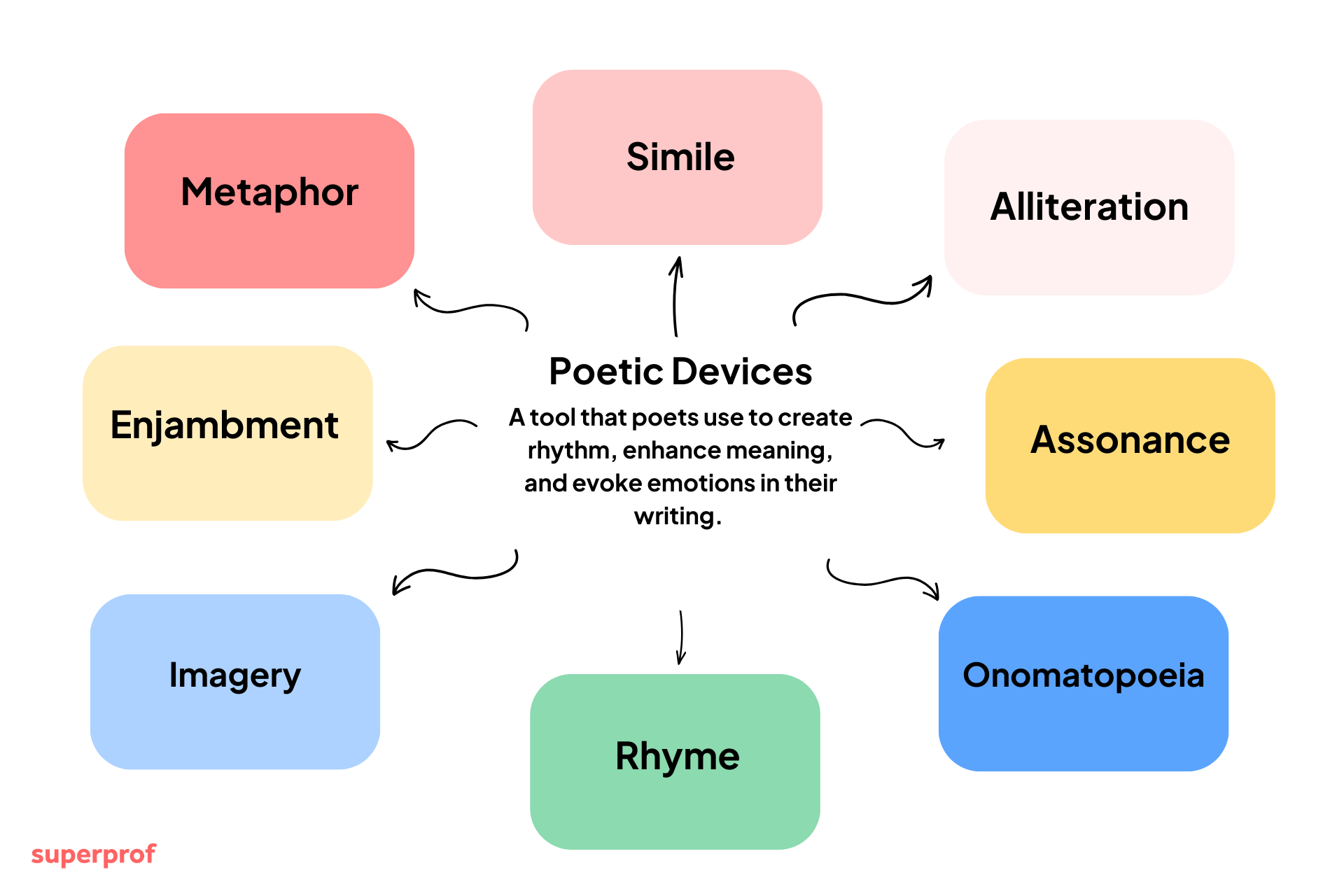
This graphic illustrate just a few of the poetry techniques in the writer’s toolkit. We organise them by the functions they fulfil before we study their individual characteristics and effects.
Poetic form take a broader perspective. They count among them poetic structure, as well as other devices listed above. A poem’s stanzas, the language the writer uses, the sounds it encourages the reader to supply… All of these are part of the poetic form.
Mood and Tone in Poetry
Your English Literature exercises may task you to identify the poem's tone and mood. Those two qualities may represent many things. These are the aspects your exam questions
The emotional atmosphere the poem creates.
Conveyed through: imagery, setting, devices
Example: gloomy, tense, joyful, eerie.
Purpose is subjective; it's how the reader interprets the work.
The poet’s attitude towards the subject.
Conveyed through: word choice, syntax, form
Example: satirical, joyful, melancholic.
Purpose: objective; it's how the writer intended the work.
Are Poetic Devices and Techniques the Same Thing?
A poem can feature a variety of poetic devices and poetic techniques. These aspects work together to help bring a poem to life. These two terms are often used interchangeably as they point us in the same direction2.
When analysing a poem, it's important to identify the poetic devices in terms of their primary function and direct examples.
But they're fundamentally different, from the perspective of poetic analysis. Furthermore, they're separate from literary devices, another oft-confused aspect of writing. Here, you can see the clear differences between these writing tools.
| 💬 Term | 📖 Meaning | 🔍 Examples |
|---|---|---|
| Poetic device | A tool the writer uses to make their writing more effective. | Metaphors, similes, rhyming schemes, and so on. |
| Poetic technique | The way the writer applies the tool. | Using cacophony with imperfect rhyme to create an unsettling poem. |
| Literary device | A broader term that encompasses all types of writing, including prose. Typically applied to a small passage, rather than the entire text. | Symbolism, irony, foreshadowing, etc. |
Try not to get confused when you see 'poetry techniques' or 'literary devices' while revising English Literature. Consult with your English teacher on your exam board's preferred term in their poetry analysis questions.
Rhythm, Structure, and Form Poetic Devices
Poetry is when an emotion has found its thought and the thought has found words.
Robert Frost
Poetic forms refer to the specific structures and patterns that poems can follow3. Each form comes with its own set of rules regarding line length, metre, rhyme scheme, and stanza organisation. These forms help shape the content, tone, and rhythm of a poem, often reflecting tradition or enhancing meaning through their constraints.
Rhythm
Rhythm guides how the poem is read, sets the emotional pace, and can echo the poem’s theme. Slow and steady for calm; quick and erratic for tension.
Rhythm in poetry refers to the pattern of beats or stresses in spoken or written language. It’s created by the arrangement of syllables—both stressed and unstressed—and is central to a poem’s musicality and flow. While metre refers to a specific measured pattern (like iambic pentameter), rhythm is the overall sound and cadence of the poem, which may or may not follow a strict metrical structure.
Quite apart from rhythm, the poem's structure also guides the reader to its intended meaning and the emotions it's meant to convey.

Enjambment
This word comes from the French verb enjamber, meaning 'to stride over'. In poetry, it represents a sentence or phrase that runs over into the next line or stanza without a pause.
Couplet
A couplet consists of two lines of poetry that typically rhyme and have the same metre. Couplets are often used to conclude a poem or emphasise a point.
Caesura
This word literally means "a pause about the middle of a metrical line". And so it appears in poems, a pause in the middle of a poetic line, often marked by punctuation.
Metre
Stanza
Stanzas are to poetry what paragraphs are to literature. They service to convey a single idea with all the description that idea needs to suit the writer's meaning. The couplet, mentioned above, is a type of stanza. These are also types of stanzas.
3️⃣ Tercet 3️⃣
- a three-line stanza
- haikus are a type of tercet
- Example: Lord Tennyson "The Eagle"
4️⃣ Quatrain 4️⃣
- a four-line stanza
- typically AABB or ABAB pattern
- Example: William Blake “Auguries of Innocence,”
1️⃣ one-line 1️⃣
- a standalone line
- typically used for emphasis
- Example: Pablo Neruda "Keeping Quiet"
Some poets use fixed forms like sonnets or villanelles to explore tight structure and repetition. Others use free verse to break from convention and create more fluid, expressive works. Recognising poetic forms allows readers to better understand a poem’s purpose and the poet’s stylistic choices.
Poetic structural devices are techniques that shape the form and framework of a poem—such as line breaks, stanza patterns, metre, and visual layout—helping to organise ideas, guide rhythm, and enhance meaning.
- Refers to how a poem is shaped and structured (line by line)
- Examples include rhyme schemes, metre, and enjambment.
This table spells out their functions and shows you how to use poetic devices.
| Form | Description | Example |
|---|---|---|
| Sonnet | 14-line poem, usually iambic pentameter, with a set rhyme scheme (e.g. Shakespearean or Petrarchan) | Shakespeare's Sonnet 18: 'Shall I compare thee to a summer's day...' |
| Haiku | 3-line poem with 5-7-5 syllable structure, typically about nature or moments of beauty | An old silent pond / A frog jumps into the pond— / Splash! Silence again. |
| Villanelle | 19-line poem with two rhymes and repeating lines; structured as 5 tercets and a quatrain | Dylan Thomas's 'Do not go gentle into that good night' |
| Limerick | 5-line humorous poem with AABBA rhyme scheme and bouncy rhythm | There once was a man from Peru / Who dreamed he was eating his shoe... |
| Ballad | Narrative poem in quatrains with ABAB or ABCB rhyme, often tells folk tales or tragic love stories | 'The Rime of the Ancient Mariner' by Samuel Taylor Coleridge |
| Ode | Formal, often lyrical poem praising a person, place, or thing | 'Ode to a Nightingale' by John Keats |
| Elegy | Reflective poem lamenting the dead or loss | 'Elegy Written in a Country Churchyard' by Thomas Gray |
| Epic | Long narrative poem about heroic deeds and events significant to a culture | Homer's 'The Odyssey' |
| Free Verse | Poetry without regular metre or rhyme; follows natural speech patterns | Many works by Walt Whitman or Langston Hughes |
| Blank Verse | Unrhymed iambic pentameter | Milton's 'Paradise Lost' |
| Concrete Poetry | Poetry in which the layout or shape on the page contributes to the meaning | A poem shaped like a tree when describing one |
| Acrostic | Poem where the first letter of each line spells out a word or message | S-U-N spells down the side: 'Shining high / Under skies / Never failing' |
| Epigram | Brief, witty, and often satirical poem | “Candy / Is dandy / But liquor / Is quicker.” — Ogden Nash |
| Narrative Poem | Tells a story with characters and plot, often in verse form | 'The Raven' by Edgar Allan Poe |
| Dramatic Monologue | Single speaker addresses a silent listener, revealing character and situation | 'My Last Duchess' by Robert Browning |
Sound Poetic Devices
Different types of poetic techniques are used in literature to create a memorable listening experience, as readers are more likely to remember them due to their engaging phrasing and pleasing sound.
One of the most effective ways to make a poem memorable is through the use of sound devices, as it is recited. First, let's take a look at the three most-used sound devices in poetry.
Alliteration
- Repetition of the initial consonant in a series of words
- Easy to spot as it involves the first letter or the first two blended sounds
- Example: Soon the sun’s warmth makes them shed crystal shells
Assonance
- Repetition of vowel sounds in a series of words
- Usually appears in the middle of a phrase or stanza, whether as a vowel or vowel sounds
- Example: And the silken sad uncertain rustling of each purple curtain
Consonance
- Repetition of consonant sounds in a series of words
- Usually appears in the middle of a phrase or stanza, whether as a consonant or consonant sounds
- Example: Tyger Tyger, burning bright,/ In the forests of the night
While the above three sound devices focus on single-sounded vowels and consonants, other poetry techniques create a sense of melodic rhythm through repetition of similar-sounding words, as well as imitation of certain sounds.
Rhyme
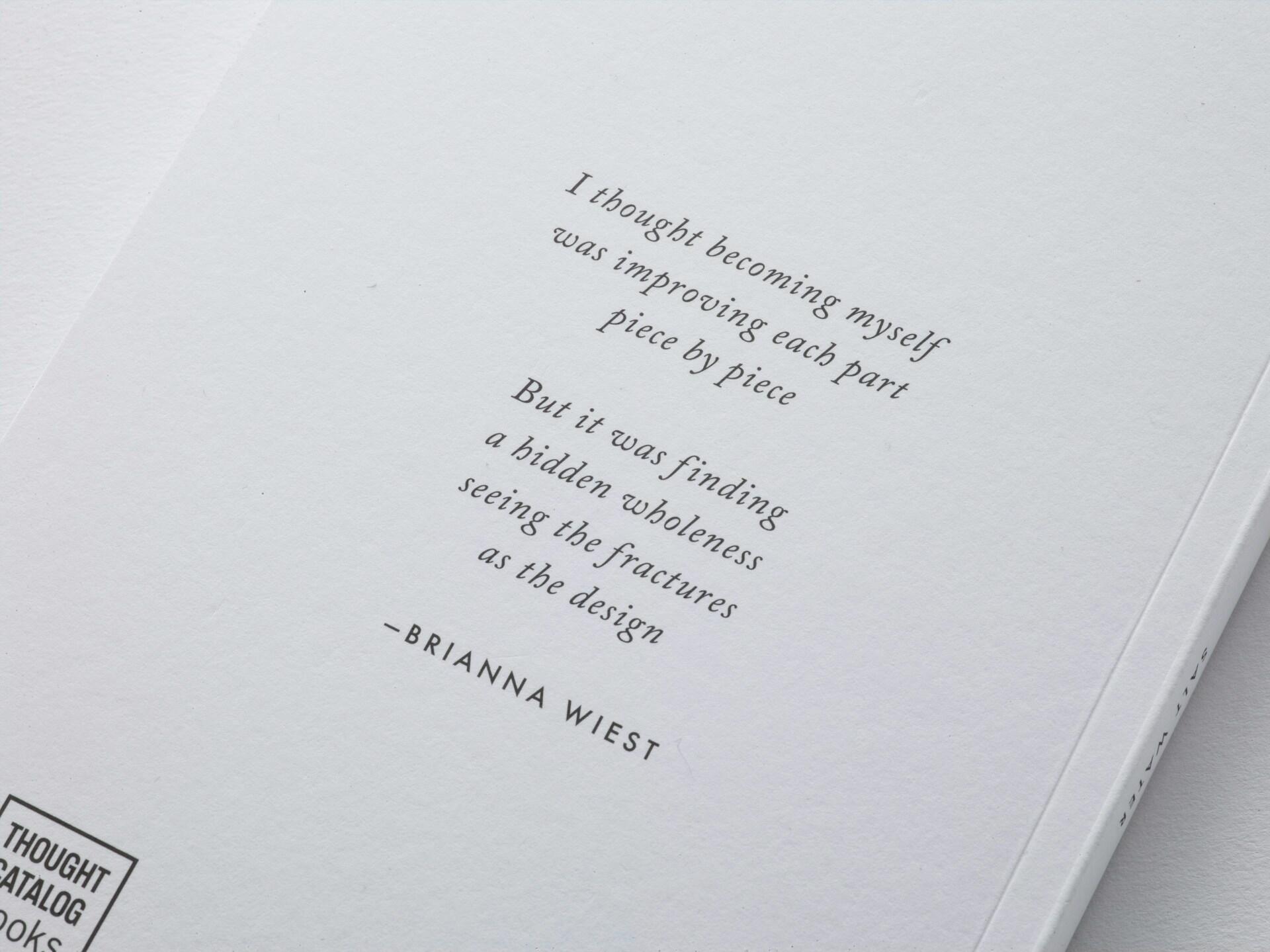
Rhymes come in several types, but they all serve to give the poem musicality, making them aesthetically pleasing. These four examples are among the most common types of rhyme.
"Once upon a midnight dreary, while I pondered, weak and weary...”"
The great man down, you mark his favourite flies;
The poor advanced makes friends of enemies.
From Longfellow's Daylight and Moonlight:
Filled and overflowed the night
With revelations of her light
Clothed in rainbows of living colour.
Flashes of lightning, rolls of thunder.
Onomatopoeia:
Supplying sounds - characters' voices and ambient noises - is one of reading's greatest delights. Often, poets help readers imagine these sounds by inserting them into their text. That is the definition of onomatopoeia, which enables us to imagine those sounds as we read them.
We wrap this section up with two opposing poetic sound devices and their effects. Were you to practise poetry exercises for beginners, you'll need to know about them.
😣 Cacophony 😣
- 📖 Definition: harsh, jarring sounds.
- 🔎 Example from John Milton's "Lycidas": "Grate on the scrannel pipes of wretched straw,
The breaking twigs snapped underfoot with crunch and crack."
- ✅ Why it works: Harsh consonant clusters (gr, scr, cr) and plosive sounds (k, t, g) create a jarring, discordant effect.
🎶 Euphony 🎶
- 📖 Definition: pleasant, harmonious combinations of sounds.
- Example from John Keats' "Ode to a Nightingale": The murmurous haunt of flies on summer eves.
- ✅ Why it works: 'murmurous' to creates a calm, flowing sound while the imagery the words create reinforces the sense of tranquillity.
Poetic Techniques for Figurative Language and Meanings
Writers use figurative language - descriptive words and phrases - as another way to expand symbolic and meaningful ideas. The poetic devices writers use impact how their audience should read your work. These poetry techniques convey emotions through comparison and emphasis.
Metaphor
This comparison technique signals that one thing isn't just like another, it is the other thing, at least, in concept. Metaphors offer readers a new perspective by delivering a relatable example of what the writer wishes to describe.
Simile
Unlike the metaphor, which presents one thing as being another, the simile indicates that one thing is like another.
Imagery
When a poet describes something so vividly that it appeals to the reader's senses, it causes them to imagine that sensation happening to their own body.
Symbolism
Writers use symbolism to represent bigger, often intangible ideas or themes, like love, time, and experiences. Typically, they do so using ordinary items.
Personification
This technique entails describing something (non-human) as having human-like qualities.
Hyperbole
To create a dramatic effect, writers use hyperbole; an exaggerated description of the action, object or feeling in question. Hyperbole can provoke laughter, intensify imagery, and underpin emotions.
Irony
Irony is a great way to express the distance between a situation and it not being what you thought it should be. Writers use these literary devices to express implied meaning.
Juxtaposition
Poets may contrast two elements to create tension, heighten difference, and prod the reader towards deeper thought. Typically, this literary device exposes the dual nature of the object or person being described.
Crushed strawberries! Come, let us feast our eyes.
Don't forget to check out how to find an experienced teacher to take poetry lessons in London. And be sure to clip this summary table of poetic devices ahead of your first lesson. It will be a handy reference to the types of devices you'll study during your sessions.
| Technique | Definition | Example |
|---|---|---|
| Anaphora | Repetition of a word or phrase at the beginning of successive lines or clauses | We shall not flag or fail. We shall go on to the end. We shall fight... |
| Epistrophe | Repetition of a word or phrase at the end of successive lines or clauses | ...of the people, by the people, for the people. |
| Antithesis | Juxtaposition of contrasting ideas in a balanced structure | It was the best of times, it was the worst of times... |
| Chiasmus | A phrase or sentence repeated in reverse structure (not necessarily the same words) | Never let a Fool Kiss You or a Kiss Fool You. |
| Antimetabole | Exact repetition of words in reverse grammatical order | Ask not what your country can do for you – ask what you can do for your country. |
| Hyperbole | Deliberate exaggeration for emphasis | I’ve told you a million times. |
| Litotes | Understatement using a negative to affirm a positive | He’s not unfamiliar with poetry. |
Rhetorical Devices in Poetry
What's in a name?
William Shakespeare, Romeo and Juliet
Rhetorical devices are techniques used to persuade, emphasise, or create memorable language through repetition, contrast, and structure4. These devices often overlap with those used in speeches and prose, enhancing the impact of a poem’s message or theme.
Rhetorical devices are common literary devices, found in all types of written works, from stage plays to detective novels.
The Rhetorical Question
Posing a question you don’t expect an answer to is a way of drawing attention to a central theme or idea. Writers use this poetic device to provoke the reader’s thoughts and hint at their main theme.
Shakespeare's above-quoted line is a timeless rhetorical question that invites the reader to think about the concept of identity. The writer goes on to explain that “A rose by any other name would smell as sweet”. Thus, he proves that one’s identity is not as important as their inherent qualities.
The rhetorical question sets the stage for the other rhetorical devices featured here. Each represents a question that demands no answer, only deep thought.
Antithesis
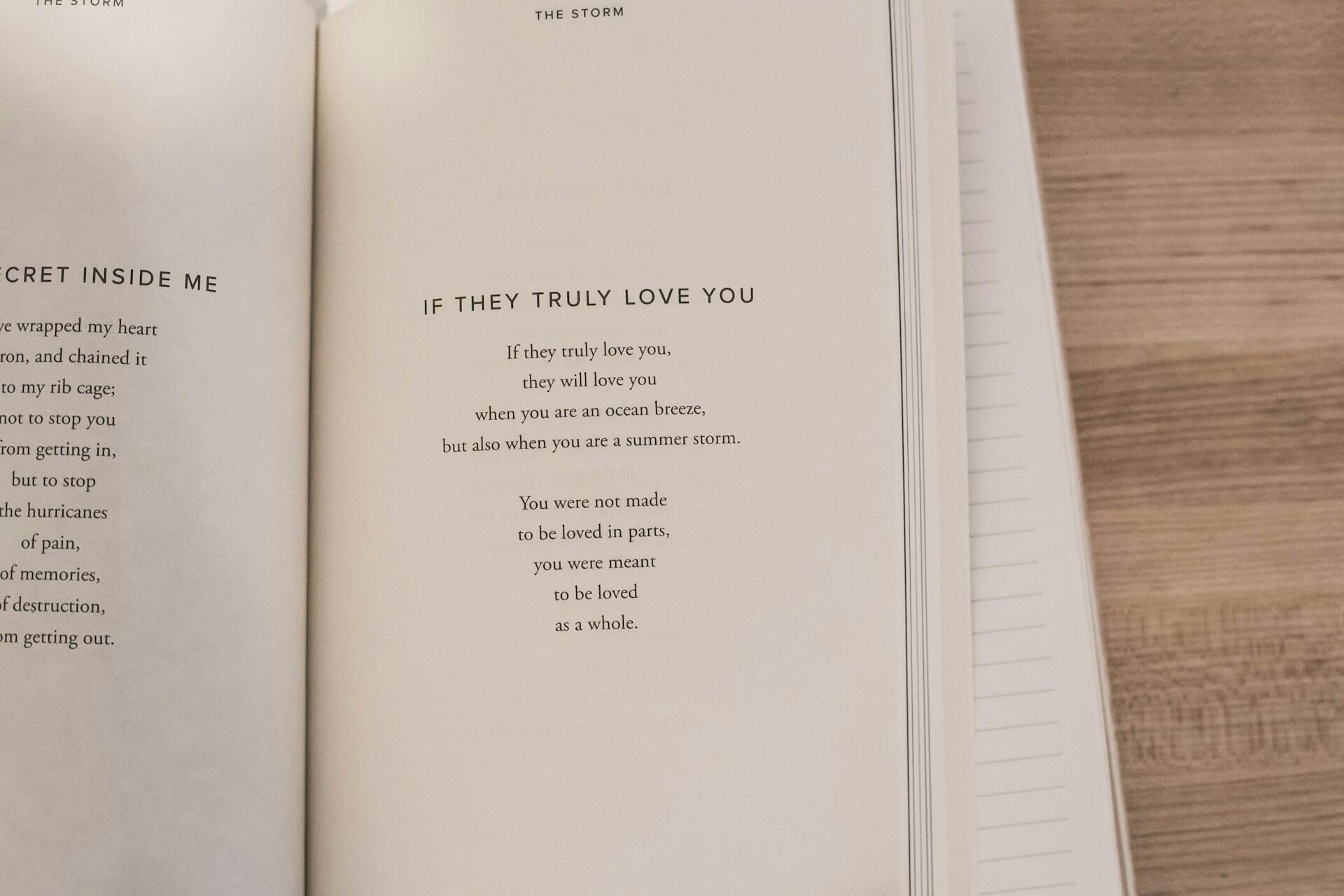
Posing opposing elements sounds suspiciously like juxtaposition, but it’s more like a superlative construction. Typically, one idea is better than the other, though both are acceptable.
Anaphora
I have a dream...
Martin Luther King Jr.
Ideas are often made memorable through repetition, a technique called anaphora. Writers use this literary device in speeches, poems, and essays by repeating the words that start sentences. Martin Luther King's "I Have a Dream" speech may be the most famous example of such.
It allows the writer to keep their central theme at the forefront of their text.
Apostrophe
This literary device allows the writer to change their focus from their audience, the reader, to some 'other'. This technique is easy to recognise, as the apostrophe often starts with "O".
Ultimately, the decision of which poetic techniques to use is personal. The writer may not change their writing style, but they will use all the tools at their disposal to make their work most effective.
You'll study poetic forms, structures, and rhythms in your poetry courses in Glasgow. Be sure to bring this list of poetic forms with you so you'll be prepared when your teacher brings the subject up.
| Poetic Device | Definition | Example |
|---|---|---|
| Alliteration | Repetition of initial consonant sounds | Peter Piper picked a peck of pickled peppers. |
| Assonance | Repetition of vowel sounds within nearby words | Hear the mellow wedding bells. |
| Consonance | Repetition of consonant sounds, typically at the end or middle of words | The lumpy, bumpy road. |
| Anaphora | Repetition of a word or phrase at the beginning of successive lines or clauses | We shall not flag or fail. We shall go on to the end... |
| Onomatopoeia | Words that imitate sounds | Bang, crash, hiss, buzz. |
| Rhyme | Repetition of similar sounding words at the end of lines | Twinkle, twinkle, little star / How I wonder what you are. |
| Personification | Giving human characteristics to non-human things | The wind whispered through the trees. |
| Enjambment | A line continues without a pause beyond the end of a line or stanza | The sun hovered / between the hills... |
| Metre | A rhythmic structure of stressed and unstressed syllables | Shall I compare thee to a summer's day? |
| Caesura | A strong pause within a line of poetry | To be, or not to be — that is the question. |
| Mood | The emotional atmosphere created by the poem | Dark, eerie, joyful, nostalgic... |
| Tone | The poet's attitude or voice in the poem | Sarcastic, formal, admiring, angry... |
| Symbolism | Using an object or idea to represent something deeper | A dove symbolising peace. |
| Allegory | A poem where characters/events symbolise broader moral or political meanings | Animal Farm as a political allegory. |
| Allusion | A reference to another work, person or event | He met his Waterloo. |
| Euphony | Pleasant, harmonious sounds | Season of mists and mellow fruitfulness... |
| Cacophony | Harsh, jarring sounds | With throats unslaked, with black lips baked... |
| Chiasmus | Reversal of grammatical structures in successive phrases | Never let a Fool Kiss You or a Kiss Fool You. |
| Antimetabole | Repetition of words in reverse order | Ask not what your country can do for you — ask what you can do for your country. |
| Couplet | Two consecutive rhyming lines with the same metre | So long as men can breathe or eyes can see, / So long lives this... |
| Poetic Forms | Types of poem structure (sonnet, ballad etc) | A 14-line Shakespearean sonnet. |
| Free Verse | Poetry without consistent rhyme or metre | Modern, conversational poetry without a strict form. |
| Concrete Poetry | Poetry where the visual arrangement of text contributes to meaning | Words shaped like a tree to reflect the poem's theme. |
| Confessional Poetry | A personal, often emotional or autobiographical form of poetry | Sylvia Plath’s 'Daddy' or 'Lady Lazarus.' |
References
- “Poetic Devices List - Check Types, Definition, Uses & Examples.” https://testbook.com/english-grammar/poetic-devices. Accessed 3 Aug. 2026
- Just Poetry . Poetry Techniques: An Introduction to Different Poetic Device. 17 Jan. 2023. https://justpoetry.net/poetry-techniques/. Accessed 3 Aug. 2026
- admin. “Unlocking Poetic Syntax: How Rhythm Shapes Meaning in Poetry - Literary Devices.” Literary Devices, 8 Nov. 2025, https://literarydevices.net/unlocking-poetic-syntax-how-rhythm-shapes-meaning-in-poetry/. Accessed 3 Aug. 2026.
- Alex, Simmonds. The 27 Poetic Devices You Need to Know. 27 Apr. 2022, https://prowritingaid.com/poetic-devices. Accessed 3 Aug. 2026.
Summarise with AI:
Did you like this article? Leave a rating!

 Loading...