


If you’re new to football and can’t understand why the ref keeps blowing their whistle when an attack is just breaking out on the pitch, there’s a good chance that what you’re witnessing is the infamous offside rule. This is generally the one rule that confuses those who are new to the sport, so don’t worry, you’re not alone! It’s essentially when a player receives or touches a through ball while they are nearer to the opponents’ goal line than both the ball and the second-to-last opponent. However, being in an offside position by itself isn’t cause for the ref to reach for their whistle; they need to interfere with active play, such as receiving the ball, challenging an opponent, or gaining an advantage from their position. After reading this article, the next time you see it in person or on television, you’ll be able to explain to the room exactly what’s going on!


The Offside Rule in One Sentence
What does it mean to be offsides in football? Okay, to a complete beginner, that paragraph might have been quite the mouthful. Let’s break it down into a single sentence. The offside rule could be described more concisely as ‘a player cannot gain an unfair attacking advantage by being behind the opposing defence when a teammate plays the ball to them.’
The Simplest Accurate Version of the Rule
While concise, that all sounds rather technical, so let’s break that down into everyday words so that you can explain it to others with ease. A player is in an offside position if any part of their body that isn’t their arms is in the opponents’ half and nearer to the goal line than both the ball and the second-to-last opponent.

If this scenario does play out during an attack, the referee then needs to determine if they interfered with the attack, and if they’re satisfied that they did, they will call for a foul. This is why we have offsides rule in football!
Why It Exists At All
Why is offsides a rule in football? When you’re new to anything, it’s always good to question why things are the way they are, right? Rather than blindly following the rules, it helps with your understanding if you know why they are in place in the first place. Referees don’t call offside for the fun of it or simply to interfere with an exciting game. The rule was made in the interest of making the game fairer, as it stops attackers from simply waiting beside the opponent’s goal for an easy pass.
The Three Conditions
Knowing how to recite an extract from the rule book and knowing how to apply it to a game are two different things. In order to ensure that you’ve got a good grasp of the rule and know when you’re seeing this offence unfold in front of you, you can separate the decision into three basic questions.
Position: Where the Player Is
The first question that you’re going to want to ask is, ‘Where is the player?’ Remember, the player must be in the opponents’ half and closer to the goal line than both the ball and the second-to-last opponent.
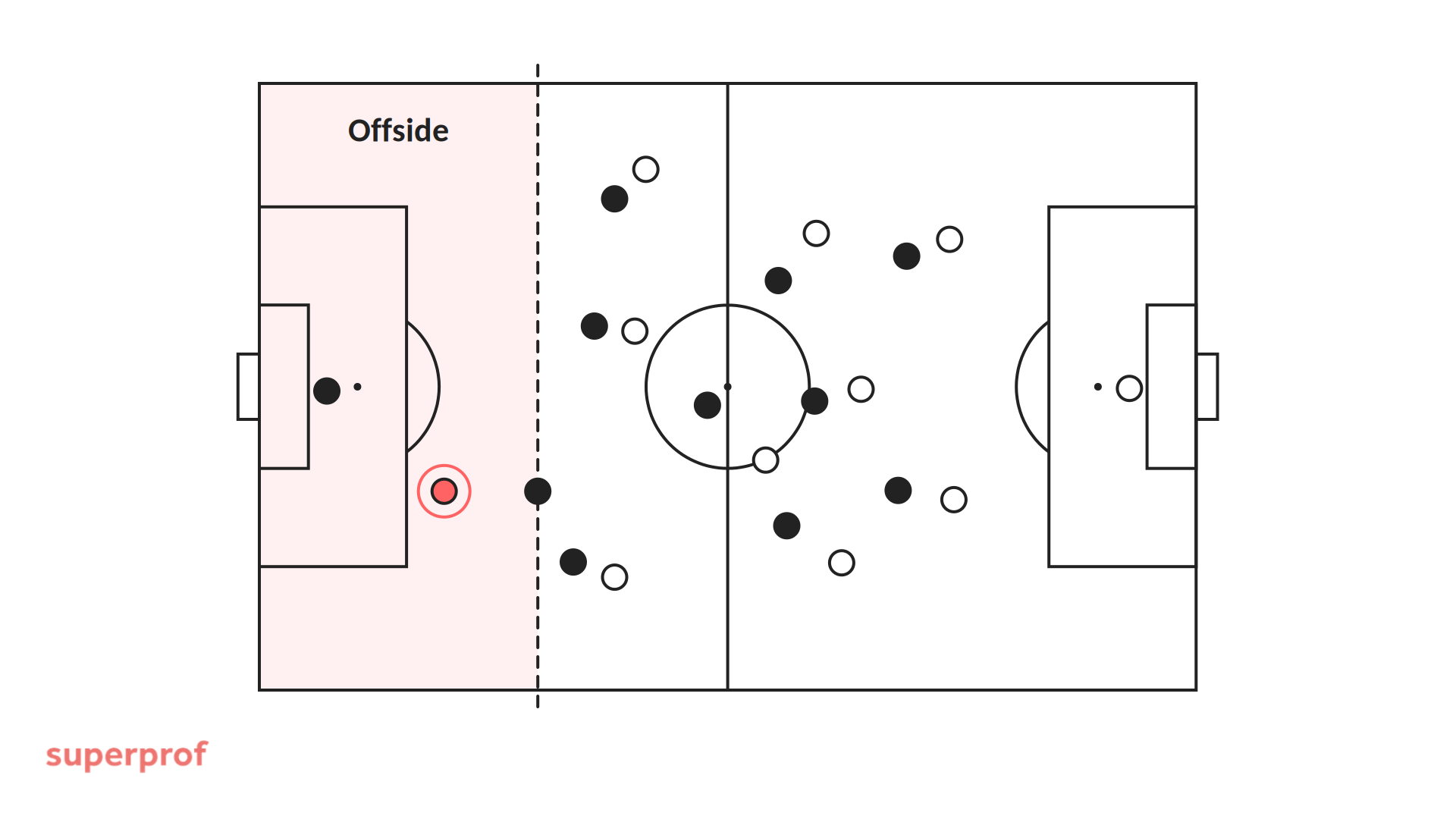
In most cases, that’s going to be the opposing side’s last defender. If they happen to be side by side with the opposition’s last defender, then they aren’t offside; they need to be behind them! Understanding soccer positions can help explain how defenders coordinate their movements to catch opposing attackers offside.
Involvement: What the Player Does
The second question is whether the player becomes involved in active play. So, if the answer to the first question is that they are indeed in an offside position, whether or not they are involved in the action becomes the call from here.
If the offside-positioned attacker minds their own business and stays well out of the way throughout the attack, the referee may allow the attack to continue.
Timing: When the Decision Is Judged
The final question that you’ll want to ask is when exactly the decision is judged. You’ll find that many times during a football match, you’d bet the house on a player being offside, but it turns out not to be the case. That’s generally down to the timing. So, the player could very well have been behind the defenders when they received the ball, but what’s important is where they were positioned at the moment when the ball was played.
What “Involved in Play” Means
If the player is deemed to have been in an offside position, the linesman and referee immediately look at whether they are involved in the play. Let’s take a look at what exactly qualifies as involvement in this situation.
Interfering with Play
Not every call will be as simple and straightforward as the next. However, one of the most blatant forms of interference that you’ll see from an offside player is if they receive the ball that was played by their teammate. This one is pretty black and white and makes life easy for the officials.
Interfering with an Opponent
This next one is a little less clear and requires more judgement from the referee or linesman. If the player was to interfere with one of the opposing players, then this could be cause for the whistle to blow.

Most often, this is if their position prevents someone from playing or being able to play the ball, or gets in the way of a player’s line of sight.
So, in an attack, even if the player manages to stay well out of the way of any shot threat that the team manages to get off, obstructing another player’s ability to read or challenge the attack will often be cause for an official to step in.
A team’s football formation influences how its defenders position themselves and manage space against opposing attackers.
So, not only will players need to hold back from taking a shot on target, but they'll also need to keep well out of the way of the possession altogether. This way they can help reduce the risk of the ref having to step in and making a call for the foul.
Gaining an Advantage
While you mightn’t see any cards being given, if an attacker is said to gain an advantage from an offside position, an offence will often be awarded. Most of the time, this generally comes from the attacker in question getting the ball after it rebounds or deflects from an opposing player or the goal frame.
When You Are NOT Offside
What does offsides mean in football? One way of knowing if you’re offside is knowing when you’re not. Now, we’ll flip the lens towards situations that don’t qualify as being offside.
In Your Own Half
When you’re watching a game, you might notice some attackers positioning themselves along the midpoint of the pitch while the opposition defence are right up with them. That’s because the rule we’ve covered so far only comes into effect from the halfway line and beyond. So, when you see attackers making runs from deep inside their own half and continuing forward without worrying about the offside rule, this is why!
Level with the Second-to-Last Defender
We learned how the player’s positioning relative to the second-to-last opponent is what’s crucial in determining an offside offence; however, this is only at the moment that the ball is played. A player is not offside if they are level with the second-to-last opponent at the moment their teammate plays the ball.
Behind the Ball
Another get-out-of-jail-free card when it comes to the offside rule that you can instil in your mind if you want to ensure that your attacks don’t get stopped on the pitch is to stay behind the ball.
Offside is concerned with forward positions relative to the ball and the opposition. By standing behind the ball and making your run once the through ball has been played, you can avoid the frustration of having the whistle blown after having made your run.
From a Throw-In, Corner or Goal Kick
Another rule that gets lost in the fine print is that players actually can’t be penalised for being offside if they receive the ball directly from a throw-in, corner kick, or goal kick. This means teams can play that bit more offensively without running the risk of losing possession and having their attack spoiled.
The Second-to-Last Defender
Now, both in the rule book and throughout this article, there’s plenty of mention of the second-to-last defender, but what exactly does this mean? Let’s get some clarity on this before we go any further.
Why It Is Not Always the Goalkeeper
The reason the rule specifies the second-to-last player is because the goalkeeper is, in most cases, counted as the last man back in these instances. However, this isn’t always going to be the case. In some instances, a keeper may have lost possession elsewhere on the pitch or may have had to run to the corner of their box to attempt a save. In these instances, the rule still needs to hold, so the second-closest opposing defender to the goal line is going to be the player that the officials will be keeping their eyes on.
What Happens When a Keeper Comes Out
There are few things in the game of football that are as risky as a goalie coming off their line. Generally, it’s only done when it’s absolutely necessary, since it can prove extremely costly for the team if anything doesn’t go to plan.
If the keeper does decide to leave the goal unattended and make a break away from their line, the offside calculation gets that little bit trickier.
In such a case, the referee considers the positions of the two opponents closest to their own goal line.
Other than that, the same rules apply, only with different players.
Knowing the pitch markings helps you identify important reference points, including the halfway line, when learning the rules of offside.

That's why the rule book is specially worded like that. It's not to cause confusion, but to cover all circumstances that can arrive through a football match. You'd be surprised at how often keepers need to come out of their box to make a clearance!
The Offside Trap
The offside rule can actually be used by defenders to bait the opposition into falling for a trap and losing possession. This situation, where the rule is used deliberately by defenders to turn over possession, is actually coined the offside trap, and it can be quite effective when done right.
How Defences Use the Rule as a Weapon
So, how exactly does this play out? Well, rather than allowing attackers to run behind them, defenders actually move forward together immediately before or as an attacking pass is played. This might seem like a counterintuitive move, allowing opposing players to have a clear run at their net, but if timed correctly, it will result in possession being overturned and a free kick being awarded.
VAR and Semi-Automated Offside
While it’s not going to be something that you see employed in your weekly five-a-side game or even at any of your local club’s weekly fixtures, technology is used to make these judgement calls in some instances at the professional level.
How Offside Is Now Judged at the Top Level
VAR stands for Video Assistant Referee, which is pretty self-descriptive. It basically allows officials to examine the positions of the players at the precise moment a teammate plays the ball. Semi-automated offside technology can make this process faster by using tracking data and specialised cameras to identify player positions and the relevant moment of the pass.

The technology assists the officials, while the final decision remains part of the refereeing process. Many argue that it disrupts the pace of the game when used, as it often leads to players having to stand around on the pitch for a few minutes waiting for a definitive result. Nonetheless, it can provide clarity to decisions that were missed by the officials or situations that are too tight to call.
Why the Margins Became So Controversial
You’ll likely have seen some growing controversy surrounding offside margins. If you ask any football fan who has been watching the game for more than a decade, they’ll tell you that this certainly wasn’t always the case. This mostly came about with VAR, which is essentially when technology started to be used to identify extremely small differences. While it was introduced in the interest of fairness, it can definitely make some calls that seem harsh. This divides fans like nothing else.
Particularly when a goal ends up being ruled out because of a tiny difference that was almost impossible for players, referees or spectators to see in real time. However, if it ends up saving the team that you’re supporting, then you might be quicker to forgive its implementation. So, whatever side of the fence you fall on with this particular topic, you’re now an expert on the offside rule, and you’ll be able to explain it the next time you spot it on the pitch. Who knows? Maybe you’ll even catch a call that the referee missed!
Summarise with AI:
Did you like this article? Leave a rating!

 Loading...
